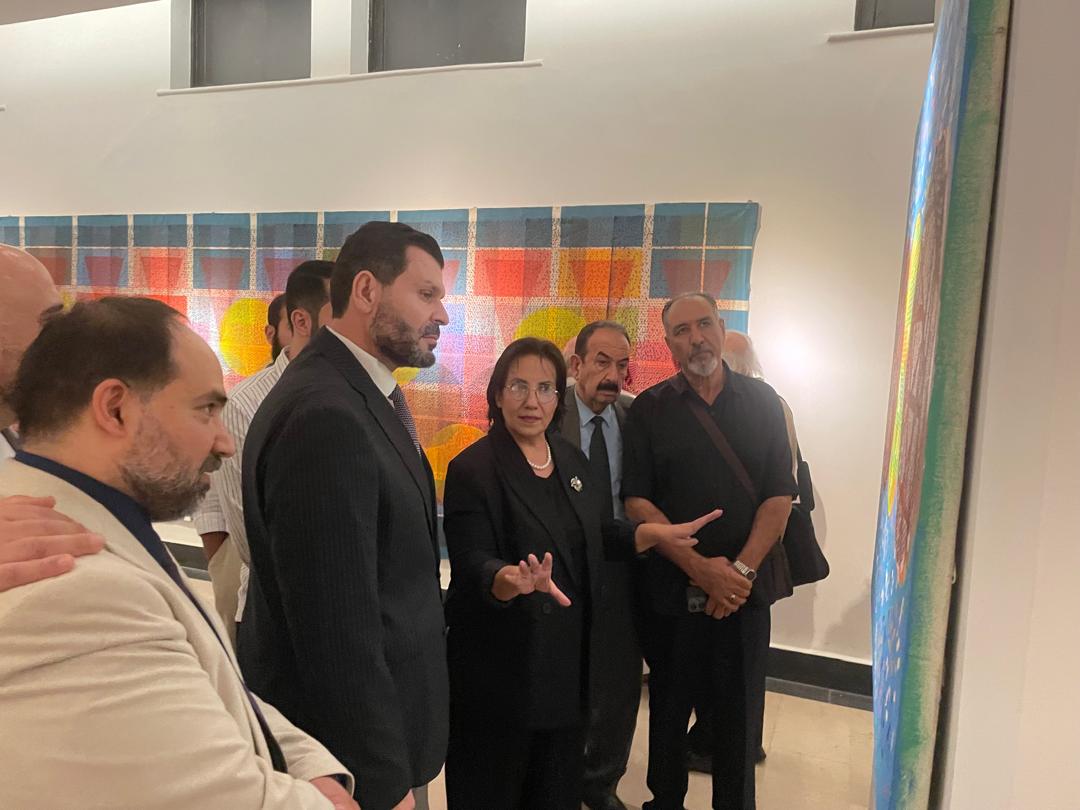
Nature's rhythms and geometric manifestations
Saad Al Qasim
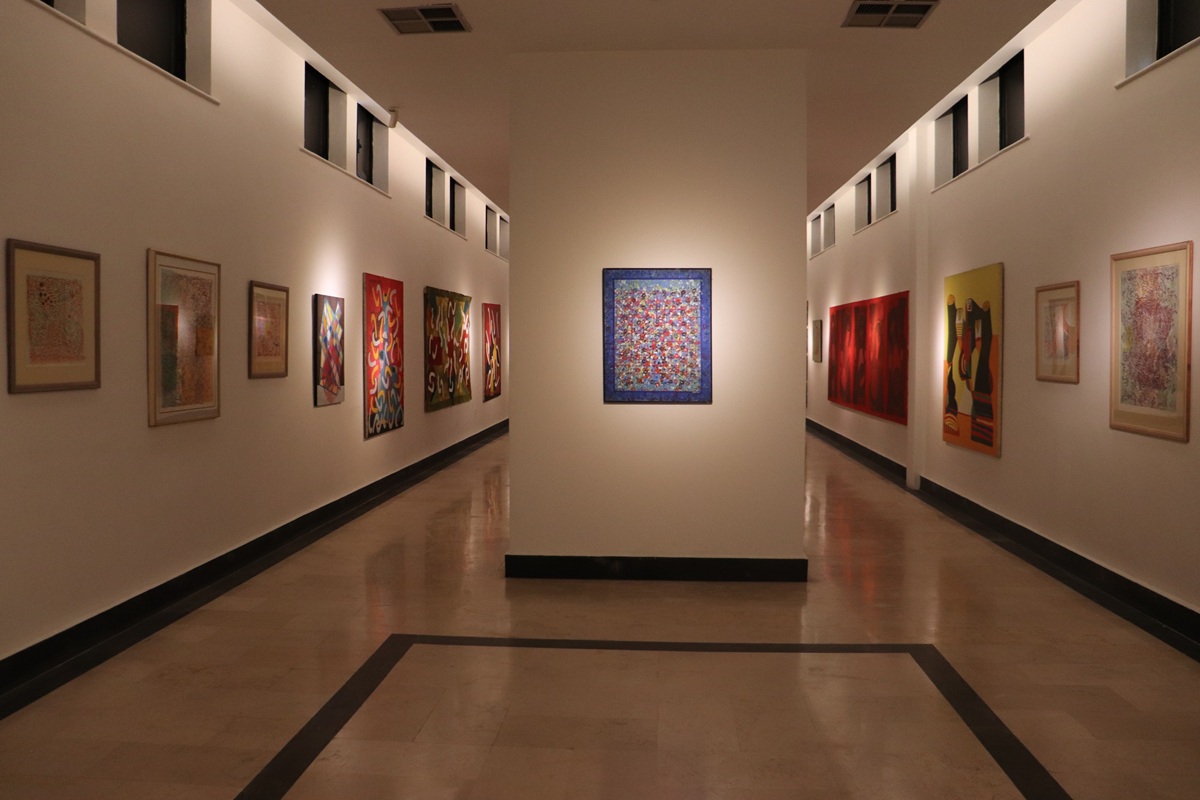
This retrospective exhibition allows to follow the transformations of an artistic experience over thirty-seven years to reach what it is today in dealing with graphic art, one of the oldest types of visual arts, and the additions that this art has witnessed in concepts and techniques.
Since the early years of her life, Enaya began to consider the small details of her family's traditional Damascene architecture, and the trees and varieties in its inner celestial space (the land of the homeland), which are polymorphic and colorful, leaving only small spaces for sunlight to infiltrate to draw on the ground small, abundant and alternating shapes at every moment when the leaves of the trees move.
On the roof of the house filled with her father's plants, where she liked to lie on her back, she had times to hope for the sky to change its colors between sunrise and moonset, and for the migrating clouds in it.
Images gathered in childhood memory quickly began to come out in the open, first with the chalk drawing on the diesel barrel, then on the watercolor drawing notebooks, and in the preparatory stage she had a new painting in the school wall newspaper, which teachers and students waited for every week.
She never painted faces or people, only the scenes and details of nature.
She was interested in music, reading stories and poetry, and following plastic art in magazines, but sports took her away from all this for many years, and as soon as she began working in the ceremonies of an engineering institution, the black inks awakened the napping talent in her, so she rushed to design black-and-white paintings that were prepared and inspired by the movement of tree leaves when caressed by the air.
Her choice to study engineering drawing was a translation of her desire to go to the formation and a prelude to her entry into the world of painting, and her leaders were a happy coincidence to get to know in her new workplace an engineer who owned a private printing press that encouraged her to implement her drawings with silk screen technology, so she rented the printing press outside the season of work in it to do a lot of experiments on printing with color technology on cardboard and then cloth, and later learned to engrave on mirrors, and presented several works from it.
At the turn of the century, paintings of a group of oil-colored jars were completed. Hence, the methods of the early diggers were renewed using clichés on giant plates. The abundance of methods of using the elements engraved on the cliché gives formal possibilities to infinity.
After her previous exhibition, which was entitled (Poetic Rhythms), her current retrospective exhibition comes with a more biased title to the visual side, with an emphasis on the geometric shape whose origins – perhaps – date back to the shapes that the sun's rays painted on the wobbling surfaces on them as they cross the interlocking wood of old windows. However, like its predecessor, it reveals the delicate sense that the artist has towards shape and color, which gives her a permanent ability to discover and find the charming harmony between them in endless abstract worlds characterized mainly by elegant vividness